
Condo Strata Property Owners as Knowledge Keepers
What is a Strata Components Knowledge Keeper, what do they do and why?
A KnowledgeBase should be the entry-point which underpins a Strata Corporation’s’ engagement and cooperation with their Strata Manager, Property Manager, Property Assessor, Depreciation Report Producer.
- Who should be motivated to have a strata components KnowledgeBase?
- Who does the collection and record keeping for a strata components KnowledgeBase?
- What is a KnowledgeBase?
- What does a condo strata property KnowledgeBase do?
- Depreciation reports in perspective
- Why should strata condo owners and Councillors commission a components KnowledgeBase?
- Benefits of a condo strata property KnowledgeBase
- How is knowledge about strata condo components gathered, organised, filed, retrieved?
- When should knowledge be added to the KnowledgeBase?
- Where are condo strata details found?
Background story
Mick O’Keefe – Co-Convenor of the Collaborative Condo Component Knowledgebase Association
I’ve been a volunteer for community organizations and projects throughout my life. I’m now officially retired after 40+ years working mostly in the business information systems sector. Now, we all hate to see our accumulated knowledge and expertise laboriously earned throughout our working lives go unused, right?
Fortunately for me, I’ve now found an engaging, productive, beneficial, value-adding interest. Which is – collecting and curating my condo strata property’s required knowledge about all the various strata property components – a ‘KnowledgeBase’.
Basically to ensure that we don’t “sleepwalk” into situations of deterioration that have been overlooked, and suddenly now require big levies or even loans to finance necessary repairs or replacements.
So, if you own a strata condo unit, my experiences with this subject might interest you as well.
What prompted me to start gathering and curating our condo strata’s common property components?
Me, with no commercially saleable expertise in building construction, plant, essential services, grounds-keeping, etc. etc. But I can read, question, listen, watch and write down what experts in these various fields share. As can just about all condo strata Councillors and owners.
The situation in most condo Strata Corporations and Councils is summed up by this observation from Tony Gioventu, executive director of the Condominium Home Owners Association -
No one is expecting a strata council to be a corporate administrator, and yet we place the operations of strata corporations often exceeding
hundreds of millions in value, on the shoulders of the volunteers, and often without the budget resources necessary to retain qualified professionals.
Volunteer Strata Councillors carry so many responsibilities to constantly deal with -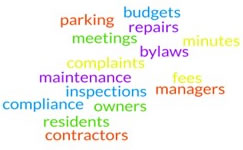
It’s scary how we strata condo property owners and Councillors are so easily and often exposed to unanticipated costly strata common property repairs and replacements.
After 18 years of different condo ownerships and Council memberships, I can personally attest to how condo strata corporations can “sleepwalk” into financial calamities that can be financially devastating for many people.
I’ve been on the receiving end of imposed cash levies on owners, and also “emergency” withdrawals from the Contingency Reserve Fund, that had to be replenished quickly through ramped-up strata fees.
Of course, our personal finances all took a pounding as a result of these events.
In most cases, levies, loans, exorbitant fees increases could have been avoided, or dealt with in ample lead-up time, if only we owners had made the effort to collect, document and monitor the ongoing condition and state of repair of the “big ticket” components of our property and building.
After much reflection, I came to the conclusion that we didn’t have to be “ambushed” by these situations and disasters.
If we just applied our own ongoing vigilance to the conditions of our strata components assets, we would always know what to look out for, and fix things in ample time.
And if Councils and owners had the right guides, checklists, toolsets and support, they could be controlling their own property assets preservation instead of relying on “hired hands” who have no actual skin in the game.
To be clear, I’m not suggesting that a condo strata components KnowledgeBase will supplant the requirements or serve as an alternative to such mandated guidance as Depreciation Reports or Property Assessments.
A KnowledgeBase is meant to serve as a source of continuing, contemporary, current first-hand observations, notations and records that should provide much of the basic content needed for D.R.s and P.A.s.
A KnowledgeBase can inform and be informed by D.R.s and P.A.s, but ultimately it is the Strata Corporation’s Council and Owners who have to decide to adopt the recommendations of a D.R.
The more current-status info that strata stakeholders have, the better they are armed to make critical financial decisions that affect them all. It’s their skin in the game, after all.
I offer more observations about the purposes and roles of D.R.s and KnowledgeBases further down in this article.
About 5 years ago now, I concluded that nobody outside our condo strata owners’ group really has our backs when it comes to caring about the state of maintenance and repairs of our property assets.
And we’re always the ultimate casualties of our own misplaced reliance on outside “helpers”.
So, being retired after many years in business systems and management, I began to compile a comprehensive digital, shareable inventory of the critical strata property components that Council and owners could use as a KnowledgeBase.
This project has been ongoing, and has benefited Council and owners in so many ways –
more specific information about all aspects of the strata property, less guesswork, less reliance on outside opinions, more control, more confidence, more informed discussions, more informed decision-making, faster decisions, more judicious spending, curb unwarranted extra strata fees, strategic funding of CRF for big-ticket items spending, avoidance of levies or loans.
And importantly, contending with “The Strata Syndrome” where suppliers & contractors often see stratas as opportunistic targets for applying elevated pricing.
We’ve also positioned our strata as a more “attractive” candidate for insurance brokers.
And keener pricing for getting our Depreciation Reports produced.
Market values of individual condo units are also preserved, as this critical knowledge about property maintenance, repairs, replacement and future requirements can be passed on to future strata Councils, owners and their heirs so they don’t have to get “ambushed” by “sleeper” issues.
The “corporate knowledge loss” that always occurs with turnover of operatives is a real problem that impacts even the best-resourced big organizations.
Small volunteer strata condo Councils are particularly vulnerable and disadvantaged by these unavoidable, recurring situations.
We are happy to share our “digital work-bench” and self-service “toolsets” for strata condo property KnowledgeBase compilation with other interested strata Councillors / owners under the formal structure of a new unaffiliated, single purpose, not-for-profit BC-registered Association, whose members address common-interest condo components issues. A structured “co-op” if you will.
An online discussion forum about strata components management is part of this co-op.
Anyone who is interested can just email for more information and discussion.
And please share / forward this article to anyone else you think it might interest.
A Deeper Dive into the Details of Strata Condo Knowledgebase Development
The who, what, why, how, when, where and of getting it done.
WHO should be motivated to have a strata components KnowledgeBase?
If we think of a KnowledgeBase as a D.E.W. (Distant Early Warning) line, every strata condo unit owner has a significant vested interest in taking every measure to avoid a big financial hit such as a special levy to pay for unforeseen / unscheduled components repairs / replacements.
So, owners who are investors / landlords could see their investment appreciation & returns strategy impacted substantially if unforeseen / unscheduled components repairs / replacements give rise to special levies, loans and/or increased strata fees.
Equally, “forever-home” resident condo unit owners should be relieved to know that a constant watch is being held to ensure that the ‘big ticket’ strata components are kept working as designed to provide them with their expected amenity of occupancy, and that inevitable repairs & replacements are factored into the long-term future outlook.
Particularly if the condo unit is to be part of their will, which their beneficiaries will inherit.
The inheritors would not appreciate an inheritance that came with an unprovided-for financial obligation to meet a share of major property repairs / replacements costs.
A couple of other general observations about strata condo ownership considerations -
- Every strata condo unit owner is a co-owner of all the common assets of the Strata Corporation.
That ownership comes with the benefits of assessed-value collateral shareholding, declarable as component assets in personal net worth declarations. (Usually embodied within the market value of the condo unit).
These assets also carry shared liability for maintenance costs which are designed to preserve the utility and maintained value of the assets. Which is partly what strata fees are calculated to cover.
An example might be say an elevator in a 3-level, 30-units strata condo building. This asset has an initial assessed replacement value of $265,500. So at that time, each strata unit owner held an $8,850 stake in this asset. With proper maintenance, the inflation-adjusted replacement value of this asset can be preserved. On the other hand, a poorly maintained, deteriorated elevator will diminish the overall market value of a condo unit.
- The care factor, and propensity for volunteering to contribute to management of the strata condo common components -
There are 3 different cohorts of interests in condo amenity and upkeep -
- Resident owners
- Non-resident Investor-landlord owners
- Tenants
The resident owners of condos are the most likely cohort to step up for volunteer activities in managing the strata property. They care about the amenity and presentation of their homes (they live there), and take a proprietary interest in saving strata operating costs and keeping strata fees as low as possible.
They are also the most likely cohort to care about By-laws, particularly those governing the required standards of good neighbourly behaviours of all residents and visitors.
Non-resident Investor-landlord owners are usually focused primarily on getting the highest possible rental fees for their units, maintaining appealing exterior presentation standards of the condo complex, while keeping strata fees to a minimum.
Tenants are not usually interested in any aspects of strata property management overall, save those that affect the amenity & upkeep of common areas facilities.
WHO does the collection and record keeping for a strata components KnowledgeBase?
The nominated resident strata property contact for contractors, access, questions, etc is the logical person to be the Knowledge-Keeper. And vice-versa.
It’s suggested that Councillors agree on a ‘curator’ of collected property elements details to store as a living ‘digital KnowledgeBase’ for the strata corporation.
The KnowledgeBase curator can act as a Council-appointed “Committee”.
(Note - the appointed curator does not necessarily need to be a Councillor, owner or resident, but must be given a precise charter, and reports accordingly to the Council)
WHAT is a KnowledgeBase?
Firstly, it is different from a ‘database’.
A KnowledgeBase is defined as -
the collection of information representing the collective knowledge of an organization, arranged for easy search and retrieval.
The applicability of a KnowledgeBase to a condo strata property translates as keeping a “weather eye” on all depreciating common property components.
There are known knowns - there are things we know we know.
There are known unknowns - there are some things we know that we do not know.
There are also unknown unknowns - the things we don't know that we don't yet know.
Just as, say, you should give your car a once-over every so often so that you might pick up on developing problems early so you can get them fixed asap before you’re facing major repairs or re-builds of engines, transmissions, suspensions, etc., so should condo components receive a regular “once-over”.
“A stitch in time saves nine” as the old truism goes.
WHAT does a condo strata property KnowledgeBase do?
Here’s what a Strata Condo KnowledgeBase basically does
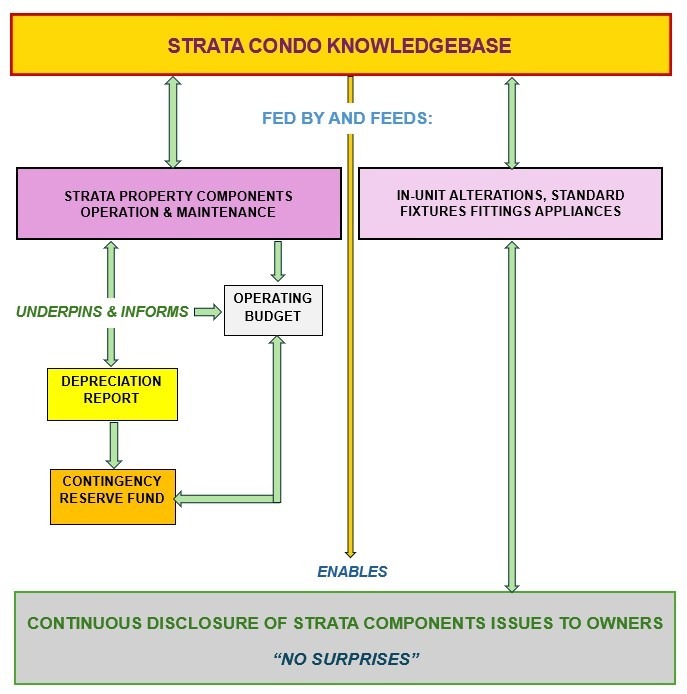
A KnowledgeBase should be the entry-point which underpins a Strata Corporation’s’ engagement and cooperation with their Strata Manager, Property Manager, Property Assessor, Depreciation Report Producer.
Strata property components Categories include such assets as
Within these Categories, there usually are some 55-75 specific Components.
As mentioned earlier in this article, a few points about mandatory Depreciation Reports -
Depreciation Reports in perspective
A D.R. is principally a financial analysis, a financial instrument akin to an actuarial assessment produced at 5-year intervals designed to inform Councils about the budgeting and future funding requirements for the Contingency Reserve Fund.
Like a Prospectus required for stock market listing, except it advises investments in specific condo components assets portfolios instead.
So a D.R. is not the same as a strata property components KnowledgeBase, whose purpose is to inform owners currently and continuously about the physical functionality, condition and management of physical components and facilities.
And not just common strata property components, but if required, also the particulars of standard in-unit fixtures, fittings, facilities and appliances.
To Summarize
A D.R. is a government-mandated obligation, to be produced by government-accredited categories of professions, using a prescribed formulaic strata-property specific-purpose actuarial methodology.
Once every 5 years, the D.R. projects the financing requirements for property components upkeep for 30 years hence.
D.R.s are not required to consider the demographics or circumstances of owners eg – retired, sole owner-occupant, fixed income pension, etc.
And as is prudent in the interests of both report producers and recipients, a typical statement by a D.R. producer will include such standard disclaimers as –
This report is not a guide to maintaining the property. Component costs and remaining lifespans can vary widely and can be affected by latent issues that are impossible to discern during a visual inspection. An indepth study of each component is beyond the scope of this report.
WHY should strata condo owners and Councillors commission a components KnowledgeBase?
Stem loss of “corporate knowledge”.
- Let’s face it - a condo strata property becomes like an abandoned orphan soon after the Developer exits the project.
- No single entity then has overall responsibility for the upkeep of the entire property.
- Volunteer condo unit owners are then left as the only parties with actual “skin in the game” to form a Strata Council to manage the property.
- The only way to protect & preserve our homes / investments is to all become active participants in managing our strata properties.
A condo strata Council should be able to readily pull up all relevant info and state of repair of any component of their strata condo property’s building, plant, equipment, facilities and landscaping for reference in doing assessments, planning, decision-making, budgeting, repairs & financing.
Benefits of a condo strata property KnowledgeBase
- more specific information about all aspects of the strata property,
- less guesswork,
- less reliance on outside opinions,
- more control,
- more confidence,
- more informed discussions,
- more informed decision-making,
- faster decisions,
- more judicious spending,
- curb unwarranted extra strata fees,
- strategic funding of CRF for big-ticket items spending = AVOIDANCE OF LEVIES OR LOANS
Collaborate and share experiences, knowledge with other people with the same situations.
Remember, condo owners are not in competition with each other for knowledge about property components and elements.
HOW is knowledge about strata condo components gathered, organised, filed, retrieved?
Initially a Councillor or nominee will take a tour of the property & building and note what physical elements are there and obvious details, and taking pics of items to tag and file.
If a Depreciation Report or a Property Assessment is available, use it as a guide.
A general worksheet (form) could be used to enter strata common areas Components and details, with fields for –
- who is collecting this info
- what Component of the property is this
- which Category should this Component be assigned to
- notes / narrative (freeform text)
- are records, documents etc available to provide relevant knowledge
As details are captured, digital files should be created and saved into folders in a system library to enable ready retrieval, sharing, uploading etc as desired.
Note
A “project resources package” for completing this exercise can be provided to co-op participants by the author of this article.
WHEN should knowledge be added to the KnowledgeBase?
A short answer would be - as events, developments affecting strata property components dictate.
Preferably, continuously when details are fresh in the mind.
And understandably, as time allows for this kind of volunteering activity.
WHERE are condo strata details found?
Throughout the entire property structures and grounds.
An “access all areas” commission must be granted to the KnowledgeBase collector by the Strata Council.
Further information & particulars about strata property components can be gathered by online searching.
In closing, again I am happy to share my “digital work-bench” and self-service “toolsets” for strata condo property KnowledgeBase compilation with other interested strata Councillors / owners under the formal structure of a new unaffiliated, single purpose, not-for-profit BC registered Association, whose members address common-interest condo components issues. A structured “co-op” if you will.
An online discussion forum about strata components management is part of this co-op.
Anyone who is interested can just email us for more information and discussion.
And please share / forward this article to anyone else you think it might interest. Here's the link to this page to share - https://condocomponents.ca/background/